

KTA’s Certified Coating Inspector Forum
Volume 5, Issue No. 2 – April 2026
William Corbett, Technical Consultant
AMPP Senior Certified Coating Inspector & Certified Protective Coating Specialist
KTA’s Certified Coating Inspector Forum is designed to provide professional development/continuing education on standards, inspection practices, new instruments, and other topics to help keep certified AMPP and FROSIO coating inspectors current. It represents the views of the author and KTA-Tator, Inc. It may or may not represent the views of AMPP: The Association for Materials Protection & Performance, even though SSPC, NACE, and AMPP standards are frequently referenced in the content.
Introduction
Yes, you read the title correctly. This issue of KTA’s Certified Coating Inspector Forum focuses on performing holiday and pinhole detection on newly installed linings inside tanks, rail cars, and other vessels with your eyes and an ultraviolet lamp. This technology can be used in conjunction with traditional low and high voltage holiday detectors. Pique your interest? Read on.
Review of Traditional Pinhole/Holiday Detection
Traditionally, pinhole and holiday detection are performed using low voltage (wet sponge) or high voltage (spark) detectors. These processes are the subject of a special release of the KTA Certified Coating Inspector Forum published in December 2024 (https://kta.com/changes-to-high-voltage-holiday-detection-standards/) and are summarized below.
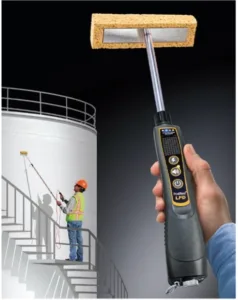
Low voltage holiday detection is used on coatings that are less than 20 mils (500 µm) in thickness. A wet-sponge detector (available from various manufacturers) consists of a wand containing a metal end-clamp with a cellulose sponge that is saturated with tap water, a ground cable that is connected to an uncoated area on the structure, and a detection unit that will audibly alarm if any pinholes or holidays are detected. The voltage setting for coatings on steel is constant (67.5v); however, some units offer a 90v setting for less conductive substrates such as concrete.
A ground wire from the detector unit is clamped to an uncoated location on the structure. The cellulose sponge is saturated with tap water, then traversed across the coated surface in a consistent pattern at a rate not to exceed one lineal foot per second. If a pinhole or holiday is present, the water from the sponge penetrates to the unprotected substrate, completing the circuit to the detector. When the circuit is completed, the detector will produce an audible and visible signal.
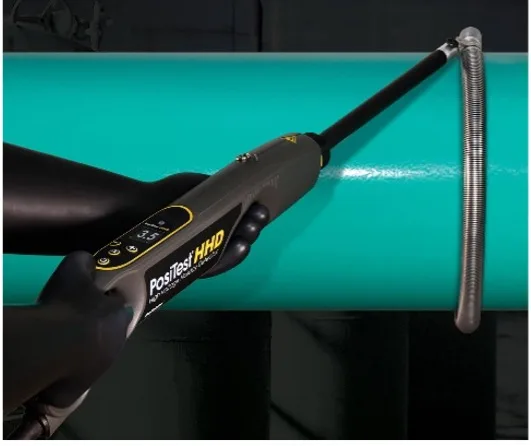
High voltage (spark) detectors (available from various manufacturers) are used on coatings/linings greater than 20 mils (500 µm) in thickness, although they may also be used on coatings/lining as thin as 10 mils (250 µm) provided the voltage is set correctly. The process is similar to low voltage testing, however metal brushes (stainless steel or brass, pictured), Neoprene rubber, or coil electrodes (pictured) are employed instead of a sponge, and the voltage setting must be calculated and entered onto the detector unit prior to use. A ground cable connects the detector to the structure to complete the circuit. An audible/visible alarm will be heard/seen, and a spark will often be visually observed as a holiday or pinhole is detected. When used on pipelines, if the pipe is grounded to earth, the ground cable can be dragged across the soil, rather than connected directly to the pipe (provided continuous contact with the soil is maintained).

Lining Systems Formulated with Optically Active Pigments (OAP)
Optically Active Pigments, or OAPs, when added to coatings during the manufacturing process, enable the coating to react to ultraviolet (UV) light – allowing for efficient inspection of large tanks and vessels to verify the continuity of the applied film. If an area contains pinholes or excessive thin coating, the area will fluoresce, identifying the locations that need to be repaired. Note that this technology is not used on pipeline coatings outdoors as there is typically too much natural light for UV light inspection. Further, air voids in a coating film that will likely be detected with high voltage spark testing will not be detected using UV light inspection. This is why visual inspection may be complementary to instrumental inspection, rather than a complete replacement.
Ultraviolet radiation is part of the electromagnetic radiation spectrum just outside the visible range and adjacent to the violet color of the visible spectrum. The wavelength for visible light is generally from 400 nanometers to 760 nanometers. The wavelength for activation of OAPs is generally from 315 nanometers through to 400 nanometers. In the visible spectrum, violet light is in the range of 400 nanometers through to 420 nanometers. This is the typical violet light range for fluorescent coating inspection. When an OAP has been added to the protective coating, the coating will glow when inspected using an ultraviolet light source.
Coatings that are formulated with OAP are traditionally used as a two-coat system, with the OAP incorporated into the first coat. Pinholes in the second coat are identified by illuminating the non-OAP topcoat using a portable ASTM E2501[1] approved ultraviolet source (flashlight), described later. Areas where the first coat is exposed through the second (at pinholes or areas of incomplete coverage) will fluoresce. OAPs, when added to the primer, can reveal the presence of exposed steel in the prime coat. Pinholes or holidays will appear black in contrast to the fluorescing coating, or if the film is excessively thin, the fluorescence may not as bright. After a non-OAP topcoat is applied to an OAP-containing primer, fluorescence will be seen at locations of pinholes or holidays. Fluorescence may also be observed if the coating is excessively thin. Other examples of the effects an inspector may observe when inspecting an OAP coating system with a UV lamp are provided later in this article.
Pinhole/Holiday Detection using Ultraviolet Lamps
When selecting which type of lamp to use during inspection, ASTM E2501 should be cited for guidance. While traditional flashlights used during normal inspections (i.e., to better illuminate the coated surface) can produce glare that can interfere with visual inspections, there is typically no flashlight glare under UV lighting since the type of light being emitted is different.
The ASTM E2501 standard establishes the radiometric requirements of the light source product in terms of required wavelength range and minimum irradiance. Additionally, it establishes safety requirements for the light source product necessary to ensure the product will not pose a threat to the visual health of humans.
UV inspections are conducted using Light Emitting Diode (LED) inspection flashlights[2]. These are often selected for inspection to enhance safety and workflow due to the flashlights being small enough to inspect hard-to-reach areas and designed to be compact, rugged, and lightweight. There is no need to wait for the coating to cure since OAP coatings will illuminate even in a wet film (i.e., the coating film does not need to reach cure before checking for holidays).
SSPC Technology Update No. 11 (TU 11), Inspection of Fluorescent Coating Systems discusses the technique and the equipment required to inspect a coating system that incorporates fluorescent properties. Note that TU 11 was last updated in 2010 (as of April 2026) and is currently being revised/updated under AMPP Subcommittee 23, Coating System Application, Maintenance, and Inspection. According to the current version of TU 11 (2010), a coating inspector with previous training and experience inspecting OAP-containing coatings for defects can use the technology with little additional training, but should follow the instructions supplied with the lamp, especially the recommended safety practices.
However, before inspecting fluorescing coatings for the first time, the inspector and the coating manufacturer’s representative should examine sample panels under the lamp that will be used to perform the inspection to learn to recognize film defects. Specifically, TU 11 recommends that the coating supplier have several panels prepared showing the following for training purposes:
• Fluorescent coat on a flat panel with pinholes
• Fluorescent prime coat and nonfluorescent finish coat on a flat panel with pinholes in the finish coat
• Fluorescent coat on a weld seam, with cracks in the coating
• Fluorescent prime coat and nonfluorescent finish coat on a weld seam, with cracks in the finish coat
• Fluorescent prime coat and nonfluorescent stripe coat on an angle
• Fluorescent coat applied below recommended dry film thickness (DFT)
• Fluorescent prime coat applied correctly with next coating applied below the recommended DFT
Here are a few examples of the effects an inspector may observe when an OAP coating system is illuminated by an UV lamp. Note that closer examination is frequently required to determine the nature and cause of appearance.
1. Fluorescent (OAP) Coating applied over a Nonfluorescent Substrate or Coating:
• Black or dark spots seen under the beam of the lamp indicate holidays or uncoated areas. Note that black dirt or grit may produce a similar appearance and be misinterpreted as a pinhole/holiday.
• Areas of brighter than normal luminosity may indicate higher film thickness, while less bright areas may indicate excessively lower film thickness.
• Areas where the coating is glowing white may indicate early detachment from the surface or hot-work damage and should be further investigated.
• Organic dust and grit may show speckled bluish-white bright spots under the light. Organic dust particles can come from rags, clothing, and protective fabric
booties. In general, if the area under the lamp is not a uniform brightness, closer examination is required to determine the nature and cause of appearance.
2. Non-fluorescent Coating over Fluorescent Coating (e.g., nonfluorescent topcoat over fluorescent primer; the nonfluorescent coat has no fluorescent pigments and
will not respond to the UV lamp)
• Primer fluorescence is clearly seen through holidays, pinholes, and cracks in the topcoat.
• Primer fluorescence may show through areas of excessively thin film build of the second coat.
• Organic dust from rags, clothing, and protective fabric booties may show speckled bluish-white bright spots under ultraviolet or violet light. In some cases, this could be misinterpreted as a pinhole/holiday.
Summary
Using an eye-safe appropriate UV light, the visual inspection of a coating manufactured with OAPs quickly highlights defects, holidays and pinholes, and potentially low film thickness during application that can be subsequently further inspected using traditional pinhole/holiday detectors and coating thickness gages. This article described performing holiday and pinhole detection on newly installed linings inside tanks, rail cars, and other vessels with your eyes and an ultraviolet lamp, in conjunction with traditional low and high voltage holiday detectors, making final inspection more effective.
[1] Standard Specification for Light Source Products for Inspection of Fluorescent Coatings
[2] Available from a variety of suppliers. Contact the KTA Instrument Sales department for information on the correct types to use.