

A Practical Guide to Reliable Pinhole and Holiday Detection in Thin Film Coatings
Introduction: Why Holiday Detection Matters in Thin Film Linings
Thin film linings play a critical role in protecting steel and other substrates from corrosion, chemical attack, and premature deterioration. These coatings are often used in environments where even a minor defect can compromise performance, safety, and service life. Despite careful surface preparation and application, small discontinuities—commonly referred to as pinholes or holidays—can occur. Holiday detection is the process of locating these defects so they can be repaired before a lining system is placed into service. For inspectors, owners, and contractors, performing holiday detection correctly is essential. Missing a defect can lead to corrosion under the coating, leakage, contamination, or costly rework down the line. When working with thin film lining systems, selecting the correct inspection instrument and using it properly is just as important as performing the inspection itself. This article explains how to conduct holiday detection on thin film linings using the PosiTest LPD Holiday Detector, an instrument designed specifically for this purpose.
Understanding Pinholes and Holidays in Coatings
Before discussing the inspection process, it is important to understand what constitutes a pinhole or holiday.
- Pinholes are very small voids or breaks in the coating film that expose the underlying substrate.
- Holidays are larger discontinuities, such as skips, voids, or thin spots, that leave the substrate unprotected.
In thin film coatings, these defects are difficult to see with the unaided eye. Further, visual inspection alone is rarely sufficient, especially when coating color and lighting conditions make defects difficult to see. Because these discontinuities expose the substrate, they create a direct pathway for moisture, chemicals, or other contaminants to reach the surface beneath the coating. Holiday detection enables inspectors to identify these areas before they result in long-term damage.
Why Low-Voltage Holiday Detection Is Used for Thin Film Linings
Holiday detectors generally fall into two categories: low-voltage wet sponge detectors and high-voltage spark testers. The PosiTest LPD is a low-voltage wet sponge holiday detector. Low-voltage detection is appropriate for thin film lining systems up to 20 mils thick. Using high voltage holiday detection on coatings less than 10 mils thick can damage the lining, produce false readings, or even burn through the film. For this reason, wet sponge holiday detection is the preferred method when inspecting thin coatings. Note that high voltage holiday detection can be used on coatings between 10 and 20 mils thick provided the test voltage is calculated and set correctly. NACE SP0188, ASTM D5162, and ASTM G62 are all aligned regarding voltage settings for high voltage holiday detection. The low-voltage method relies on moisture and electrical continuity rather than arcing used for high voltage holiday detection. This makes it a safer, more controlled inspection technique for thin film applications.
Overview of the PosiTest LPD Holiday Detector
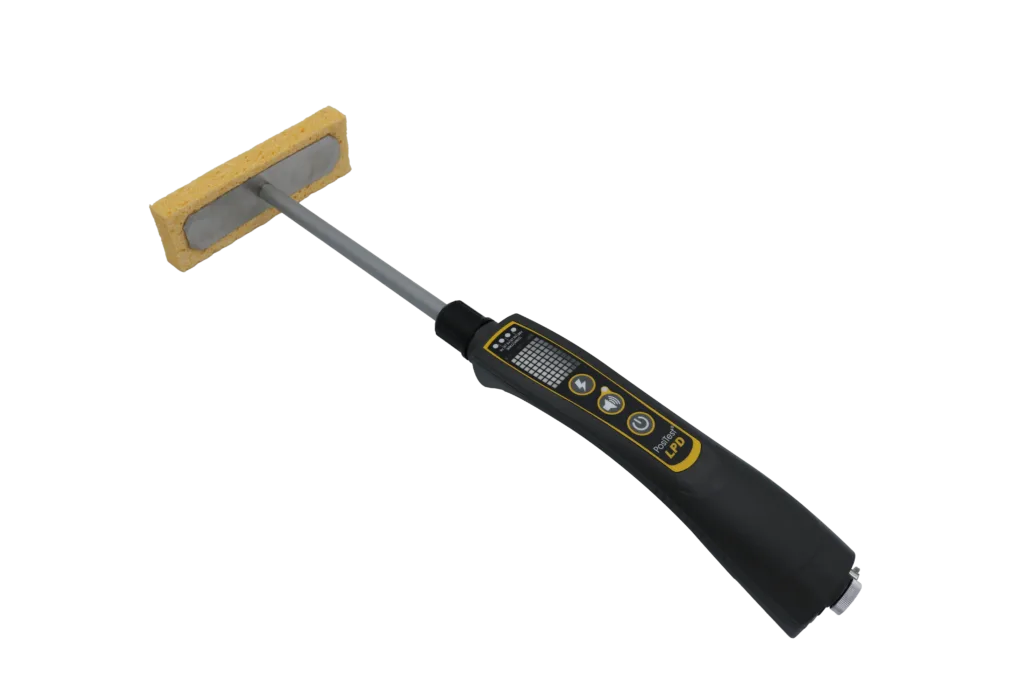
The PosiTest LPD is designed to simplify holiday detection while maintaining accuracy and repeatability. Its lightweight, ergonomic design allows inspectors to use it comfortably throughout a full workday if needed.
Key characteristics of the PosiTest LPD include:
- An easy-to-use interface
- Adjustable voltage settings
- Compatibility with thin film coatings up to 20 mils
- Long battery life
- Audible and visual indicators for detected holidays
The detector’s design supports efficient inspections without unnecessary complexity, making it suitable for both experienced inspectors and those newer to holiday detection.
Voltage Selection and Reference Standards
The PosiTest LPD allows the user to adjust the inspection voltage between 9 volts, 67.5 volts, and 90 volts. Selecting the appropriate voltage is important to ensure reliable detection. Voltage selection should always be based on the reference standard or project specification governing the inspection. Different standards may recommend specific voltage ranges depending on the conductivity of the substrate, the coating type, and thickness.. A voltage setting of 67.5 volts is the most common, however 90 volts may be used for thicker coatings or less conductive substrates. Inspectors should verify applicable requirements before beginning the inspection and confirm that the detector is set correctly. Using too low a voltage may result in missed defects.
Battery Life and Field Practicality
One practical advantage of the PosiTest LPD is its extended operating time. The instrument can operate for approximately 150 hours on a single set of AA batteries, reducing downtime and the need for frequent battery replacement.
For field inspectors working in remote locations or on large structures, long battery life improves productivity and minimizes interruptions.
Preparing for Holiday Detection
Proper preparation is essential for accurate holiday detection. Before beginning the inspection, inspectors should verify the following:
- The coating is sufficiently cured according to the manufacturer’s recommendations and project specifications.
- The surface is dry and free of dirt, oil, or debris that could interfere with electrical continuity or cause the instrument to falsely detect (surface moisture can cause “telegraphing” to the ground location, creating false positives).
- The detector is functioning properly, with batteries installed and voltage set correctly.
- All required accessories, including the sponge electrode and ground wire, are available and in good condition.
Skipping preparation steps can result in unreliable readings or missed defects.
Wetting the Sponge Electrode
Low-voltage holiday detection relies on moisture to complete an electrical circuit. To begin the inspection:
- Wet the sponge electrode with tap water. If the coating thickness is in the 10-20 mil range, a wetting agent (supplied with the PosiTest LPD Kit) should be added to the water.
- The sponge should be damp but not dripping excessively.
Water acts as the conductive medium that allows current to pass through a discontinuity in the coating. If the sponge is too dry, defects may not be detected. If it is overly saturated, water may flow across the surface and produce inconsistent results.
Maintaining proper moisture in the sponge is an ongoing task during the inspection and should be monitored regularly.
Grounding the Detector
Proper grounding is critical to successful holiday detection. The ground wire must be attached to an uncoated area of the structure being inspected.
Once connected, the inspector should verify continuity to ensure the detector is properly grounded to the substrate beneath the coating. This is known as a functional check. Without a solid ground connection, the electrical circuit cannot be completed, and holidays may go undetected.
Grounding should be checked periodically throughout the inspection, especially if the inspector moves to a different section of the structure.
Correct Inspection Technique
With the detector prepared and grounded, the inspection can begin.
The sponge electrode should be passed across the coated surface at a rate not exceeding one lineal foot per second. Maintaining this controlled pace is essential. Moving too quickly may prevent the detector from identifying defects, while moving too slowly can be inefficient and unnecessary.
The sponge should maintain consistent contact with the surface, ensuring even coverage and reliable detection.
How the PosiTest LPD Detects Holidays
The detection process is based on electrical continuity:
- When the sponge passes over an intact coating, the electrical circuit remains open.
- If a pinhole or holiday is present, water penetrates the defect and contacts the substrate.
- Because the detector is grounded to the substrate, the circuit is completed through the defect.
When this occurs, the PosiTest LPD provides immediate feedback to the inspector through:
- An audible signal
- A flashing LED indicator
These alerts clearly indicate the presence of a holiday, allowing the inspector to identify and document the defect location. Headphones are available if the work environment is noisy.
Marking Detected Holidays
Once a defect is detected, it is common practice to mark the area for repair. The recommended method is to use small pieces of painter’s tape placed near the defect.
Permanent markers should not be used. Markers can contaminate the coating surface or interfere with repair materials, potentially creating adhesion issues or additional defects.
Clear, non-damaging marking methods help ensure repairs are completed efficiently and correctly.
Common Mistakes to Avoid
Even with a reliable instrument, errors in technique can compromise inspection results. Common mistakes include:
- Failing to properly ground the detector
- Allowing the sponge to dry out during inspection
- Moving the sponge too quickly across the surface
- Using an incorrect voltage setting
- Not marking detected pinholes for subsequent repair
Avoiding these issues helps ensure accurate detection, minimizes the risk of missed holidays and helps ensure an effective repair process.
Applications for Thin Film Holiday Detection
The PosiTest LPD is suitable for a wide range of thin film lining applications, including:
- Tank linings
- Pipelines
- Secondary containment systems
- Pressure vessels
- Tank cars
- Industrial and commercial lining systems
In each case, holiday detection serves as a quality control step that verifies coating integrity before the asset is placed into service.
Why Proper Holiday Detection Saves Time and Money
Identifying and repairing defects before a structure is commissioned can prevent costly failures later. Holiday detection:
- Reduces the risk of corrosion-related damage
- Minimizes future maintenance and repair costs
- Supports compliance with project specifications
- Improves confidence in lining performance
When performed correctly, holiday detection is a proactive investment in long-term asset protection.
Conclusion
Holiday detection on thin film linings is a critical inspection activity that requires the right equipment, proper preparation, and correct technique. The PosiTest LPD Holiday Detector simplifies this process by providing reliable low-voltage detection for coatings up to 20 mils thick.
By selecting the appropriate voltage, ensuring proper grounding, maintaining sponge wetness, and following controlled inspection practices, inspectors can accurately identify pinholes and holidays without damaging the coating.
When used correctly, the PosiTest LPD makes holiday detection more efficient, repeatable, and effective—helping inspectors deliver high-quality results and protect the integrity of coated assets.