
Before beginning any painting or coating application, environmental conditions must be measured to ensure conformance to coating manufacturer requirements and long-term coating performance. Two of the more critical parameters are relative humidity and dew point temperature, both of which influence condensation and potential coating detachment risk. One of the most widely accepted field methods for measuring these conditions is the use of a sling psychrometer, as described in ASTM E337, Standard Test Method for Measuring Humidity with a Psychrometer (the Measurement of Wet- and Dry-Bulb Temperatures).
This article explains how to properly use a sling psychrometer in accordance with ASTM E337 and how to employ psychrometric charts (lookup tables) to determine relative humidity and dew point temperature before work begins.
ASTM E337 and Sling Psychrometers
ASTM E337- establishes standardized procedures for measuring atmospheric humidity using psychrometers, including both aspirated and whirling (sling) types. Method B of the standard specifically addresses sling psychrometers, which rely on whirling motion to provide sufficient airflow across the wet-bulb thermometer for accurate measurement. The standard defines requirements for thermometer construction, airflow, stabilization of readings, and acceptable accuracy limits to ensure reliable results.
Understanding the Sling Psychrometer
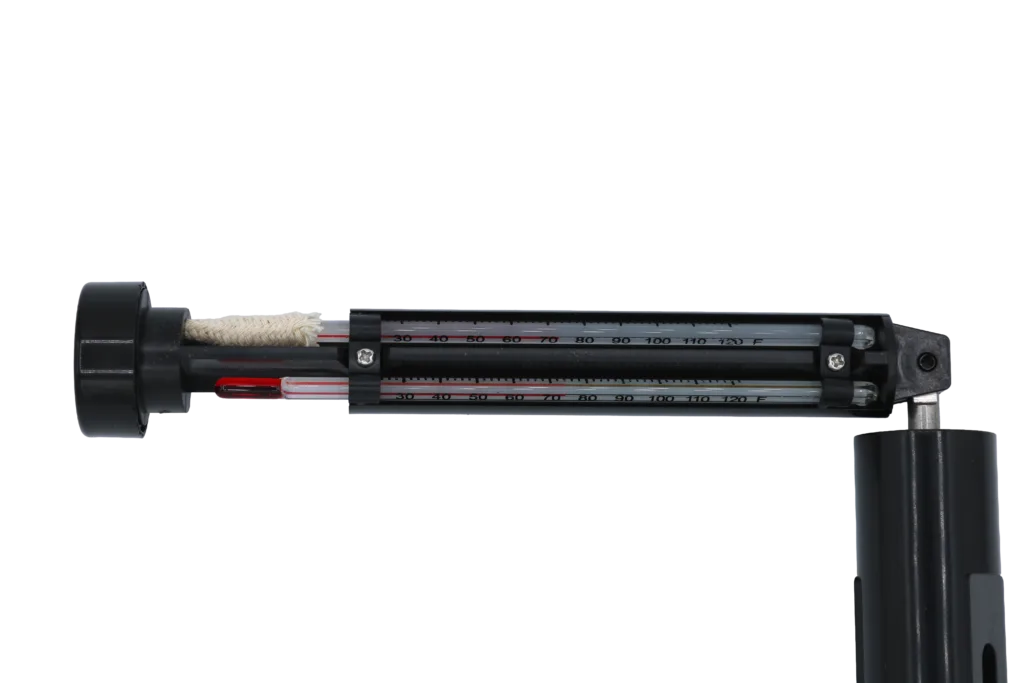
A sling psychrometer consists of two thermometers mounted together: a dry-bulb thermometer that measures ambient air temperature, and a wet-bulb thermometer that is covered with a muslin wick and cooled by evaporation. Relative humidity and dew point temperature are determined using the difference between the wet-bulb and dry-bulb thermometer readings in conjunction with appropriate psychrometric charts.
Why Relative Humidity and Dew Point Temperature Matter
Environmental conditions must be measured prior to painting or coating to prevent excessive moisture in the air from reacting with the wet coating and moisture condensation on the surface. When the surface temperature approaches the dew point temperature, condensation can occur, resulting in poor adhesion, blistering, or premature coating failure. Industry best practice states that surface temperature be maintained at least 5°F above the dew point temperature before coating operations begin, and remains a minimum of 5°F higher throughout the application and drying processes.
Preparing the Sling Psychrometer
ASTM E337requires that the wet-bulb reservoir be filled with distilled water and the muslin wick fully saturated prior to measurement. The wick must remain clean and wet throughout the measurement process to ensure proper evaporative cooling and reliable readings.
Taking Wet-Bulb and Dry-Bulb Readings
Remove the thermometer assembly from the psychrometer body and whirl the instrument to achieve adequate airflow across the wet bulb. ASTM E337 indicates a typical operating speed equivalent to approximately 180 revolutions per minute for 20 to 40 seconds. After whirling, read the wet-bulb temperature from the thermometer with the wetted muslin wick. Repeat the process without re-wetting the wick until two consecutive wet-bulb readings are within 0.5°F of each other, indicating stabilization. Record the stabilized wet-bulb temperature, then read and record the dry-bulb temperature from the other thermometer.
Calculating the Temperature Difference
Subtract the stabilized wet-bulb temperature from the dry-bulb temperature to determine the temperature difference. For example, a dry-bulb temperature of 75°F and a wet-bulb temperature of 65°F results in a 10°F temperature difference.
Using Psychrometric Charts
Locate the relative humidity chart appropriate for the local barometric pressure. Locate the dry-bulb temperature and the temperature difference on the chart. Their intersection provides the relative humidity, which should be recorded.
Determining the Dew Point Temperature
Using the corresponding dew point temperature chart for the same barometric pressure, locate the dry-bulb temperature and temperature difference. The intersection of these values indicates the dew point temperature, which should be recorded.
Verifying Conditions Before Painting
Compare the dew point temperature to the measured surface temperature. Confirm that the surface temperature is at least 5°F higher than the dew point before beginning any painting or coating operations.
Calibration and Maintenance Considerations
ASTM E337emphasizes periodic calibration of thermometers used in sling psychrometers against a reference standard. Regular calibration, commonly at intervals of approximately three months, helps maintain measurement accuracy and reliability.
Conclusion
When used in accordance with ASTM E337, a sling psychrometer provides a reliable and standardized method for determining relative humidity and dew point temperature in the field. Proper preparation, correct whirling technique, stabilized readings, and appropriate use of psychrometric charts are essential for reliable values and successful coating application.