

KTA’s Certified Coating Inspector Forum
Volume 5, Issue No. 3 – July 2026
William Corbett, Technical Consultant
AMPP Senior Certified Coating Inspector & Certified Protective Coating Specialist
KTA’s Certified Coating Inspector Forum is designed to provide professional development/continuing education on standards, inspection practices, new instruments, and other topics to help keep certified AMPP and FROSIO coating inspectors current. It represents the views of the author and KTA-Tator, Inc. It may or may not represent the views of AMPP: The Association for Materials Protection & Performance, even though SSPC, NACE, and AMPP standards are frequently referenced in the content.
Introduction
I have three questions for you as I begin this edition of the KTA Certified Coating Inspector Forum:
- Have you ever wondered how coatings industry standards come about, and how they pivot as technology advances?
- Do you have ideas for new standards, or ideas for how existing standards can be improved?
- Have you considered paying forward your hard-earned inspector certification by volunteering on committees of Standards Development Organizations (SDOs)?
Back in 2023 I was asked to present at the Annual AMPP Conference as part of the EMERG Student Outreach Program Track on standards development and maintenance. Titled, “Standards 101” I spoke about the following ten topics:
- Overcoming apprehensions of committee participation
- The purpose/function of industry standards
- How a Standard Practice (SP) is different from a Guide, Material Requirement (MR), and Technical Report (TR) within AMPP
- How industry standards are developed in AMPP and other SDOs like ASTM International, and how organizations avoid creating conflicting and/or duplicative standards
- How long it takes to develop standards
- Writing a standard, and the various formats
- Comprehending a standard
- How industry standards are used in specifications/procurement documents, including correct referencing and pitfalls to avoid when conforming to industry standards referenced in specifications/procurement documents
- When industry standards become legally binding, and
- What is involved with standards maintenance
I was subsequently asked to present an abbreviated version of the same topic at the 2024 Annual AMPP Conference during a student luncheon, where other presenters talked about the importance of becoming involved in the coating/corrosion prevention industry.
Why did I agree to make the presentations? Why am I using the KTA Certified Coating Inspector Forum to discuss this same subject? Because frankly, the number of individuals with a passion for standards development and maintenance is rapidly declining. Membership in AMPP and ASTM continues to grow, but the level of involvement is stagnant – at least in the areas of coating inspection standards. If we don’t see true engagement and ownership of standards increase, the standards that others worked so hard to development and maintain may become stabilized or withdrawn.
I was provided opportunities to become involved with SSPC standards development/ maintenance in the late 1980s, and with ASTM in the early 2000s. I continue to chair subcommittees for both AMPP and ASTM, but like many before me, I cannot continue forever. I am using this platform to call for help. Please read the information herein that I extracted from the 2023/2024 presentations of “Standards 101” and consider paying your certification forward by volunteering your time and knowledge to help both develop new standards and update/revise existing standards within your areas of expertise.
From the 2023 and 2024 Standards 101 Presentations
Overcoming Apprehensions of Committee Participation
As a younger person, getting involved with technical committee work can be intimidating. But your contributions will quickly be valued. Here’s some advice based on personal experience.
- Manage the “Intimidation Factor” of being a new member of a committee by:
- Challenging the Status Quo
- Asking “Why?”
- Offering Fresh Perspectives
- Balance thoughtful contributions with speaking simply to be heard
- Follow through on any commitments
Remember, the industry is pleading for involvement from new members and the younger generation.
Purpose/Function of Industry Standards
Here’s a summary of the purpose and function of standards from SSPC/NACE and now AMPP, as well as ASTM International and the International Organization for Standardization (ISO).
- Legacy SSPC/NACE and New AMPP Standards
- Standards, Guides, Test Methods, etc. developed using the consensus process that can subsequently be incorporated into contract documents to uniformly and consistently communicate requirements. Standard Practices and Test Methods frequently contain acceptance criteria and may specify frequency of testing.
- ASTM Standards
- Standard Test Methods and Practices developed using the consensus process that are designed to provide uniformity to testing/evaluation procedures. Test Methods are frequently accompanied by interlaboratory studies (ILS) to provide statistical validity to the method. Rarely do ASTM standards contain acceptance criteria but may specify frequency.
- ISO Standards
- Also developed using the consensus process, ISO considers their standards a “Formula that Describes the Best Way of Doing Something,” e.g., making a product, managing a process, delivering a service, supplying a material.
Differences in AMPP Documents
AMPP has five categories of documents, including Standard Practice (SP), Guide, Material Requirement (MR), Test Method (TM), and Technical Report (TR). The processes for development and maintenance of these documents are governed by the AMPP Standards Committees Operating Manual, or SCOM (2022) and overseen by the Standards Program Committee (SPC). Here’s a brief description of each.
A Standard Practice (SP) contains requirements and recommendations for the selection, design, installation, or operation of a material or system. SPs provide detailed descriptions of requirements for quality of a product or process that can be incorporated into a procurement document.
Example: NACE SP0188, Discontinuity (Holiday) Testing of New Protective Coatings on Conductive Substrates
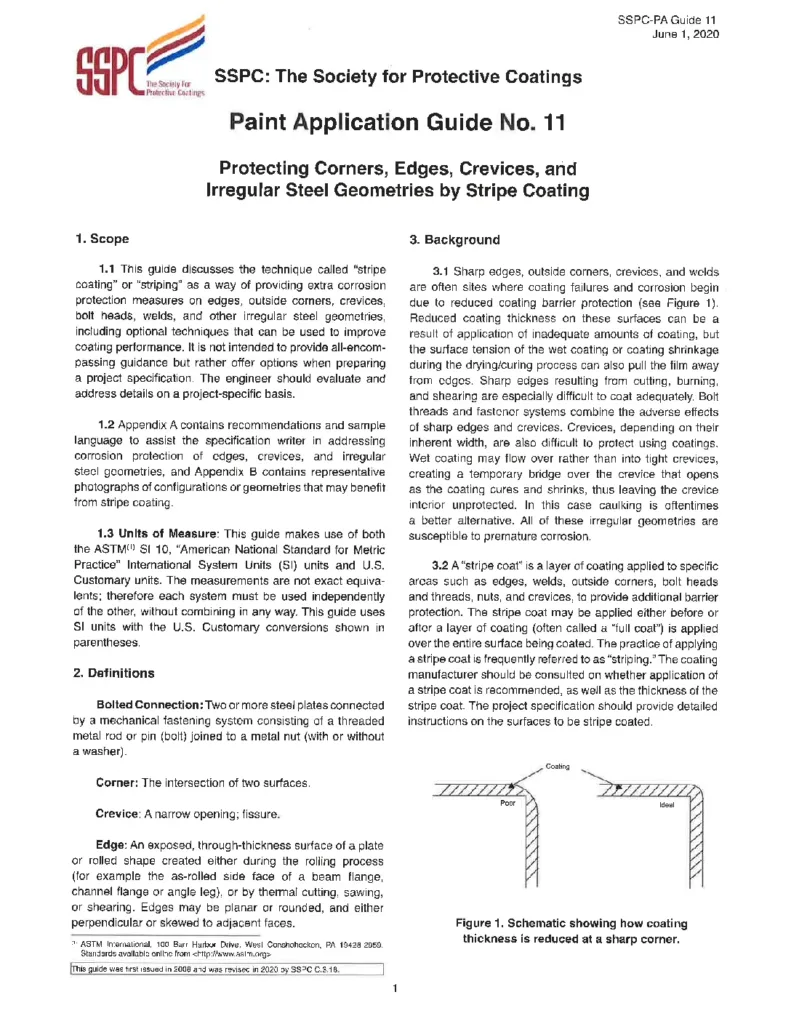
A Guide provides the user with information about alternative procedures, materials, or technologies that enable them to select the best option for a specific use. Guides may contain recommendations to assist the user to make an informed decision based on the desired outcome.
Example: SSPC Guide 11, Protecting Corners, Edges, Crevices, and Irregular Geometries by Stripe Coating
A Material Requirement (MR) defines the required or recommended characteristics of a material. MRs may include requirements for chemical composition, mechanical properties, physical properties, performance properties, and other aspects of the material’s manufacture and use.
Example: NACE MR0175, Petroleum and Natural Gas Industries – Materials for Use in H2S-containing Environments in Oil and Gas Production
Test Method (TM) contains procedures for conducting tests to ascertain the characteristics of a material, design, or operation. TMs do not include pass/fail criteria for the material, design, or operation being evaluated; these criteria may be provided in SPs or MRs.
Example: NACE TM21612, Liquid-Applied Coating Performance Test Methods for Offshore Structures
Technical Report (TR) documents practices, procedures, and technologies. They may include compilations of reference data, historical information, surveys of common practices, bibliographies on special subjects, educational material, and information on health, safety, and environmental protection. TRs follow the same development and consensus approval process as AMPP standards. Once a TR is published, no additional reviews or revisions are required. If, after ten years, a TR is still viable and of value to industry, it may be revised.
Example: AMPP TR21540-2022, Correlating Qualitative Surface Profile Assessment Methods to Quantitative Methodology on Prepared Concrete Substrates
Similarly, ASTM and ISO have various types of standards as well as process controls for both development and maintenance.
How are Industry Standards Developed?
Here’s how standards get their start, and how the industry tries to prevent developing conflicting or duplicative standards.
- AMPP
- An idea for a “document” is formally communicated using a New Project Request Form
- The form contains the Scope, Rationale, Proposed Document Project Manager (DPM), and appropriate subcommittee (SC). There are currently 25 subcommittees within AMPP
- Requires SC Chair Approval to proceed
- Other SDOs (e.g., ASTM) are slightly different
- Avoiding development of conflicting or duplicative standards
- SC Chair should have knowledge of other SDOs (e.g., ASTM, ISO) that may already have same/similar documents
- Similar standards should complement one another, e.g., ASTM D7091 and SSPC-PA 2 for Coating Thickness
How Long Does It Take to Develop a New Document?
We often hear, “I’ve got an idea for a new standard, but how long does it take to from start to finish?” It depends on several factors, including:
- The approach taken by the Document Project Manager (DPM) or Technical Contact (TC)
- The drive/enthusiasm of the DPM/TC and Task Group
- The quality of draft that is balloted
- The availability of SMEs that can knowledgeably vote on a ballot
- The outcome of ballot(s)
- The number of ballots required
- The thoroughness of the documentation of ballot outcomes to prove that the consensus process was followed
In total, it can take anywhere from 1 to 3 years (or longer).
Where Do I Start?
Here are 10 steps to get you started with standards development and maintenance:
- Consider joining an AMPP Standards Committee (SC) or an ASTM subcommittee that interests you/fits your industry.
- Attend, listen, and learn.
- Become an “Observer” on an AMPP subcommittee.
- Volunteer to join a Standard Working Group to work on a new or existing document.
- Request to become a voting member of a subcommittee.
- When applicable, submit an idea for a Standard Practice, Guide, Test Method, or Technical Report.
- If your submission is approved, agree to be the DPM or TC (i.e., don’t dump your idea and run!). Mentoring and staff support/guidance are available throughout the process.
- Express interest in becoming a subcommittee Vice-Chair and learn from the Chair
- Become the best subcommittee Chair you can be.
- Reap the rewards of knowing you contributed to our industry and made it better!
Comprehending an Existing Standard
As certified coating inspectors, we are frequently inspecting work that was supposed to be performed according to an industry standard (e.g., SSPC-SP 10/NACE No. 2, Near-white Blast Cleaning) or obtaining measurements according to an inspection standard (e.g., SSPC-PA 2, Procedure for Determining Conformance to Dry Coating Thickness Requirements). Here are 4 recommended steps for comprehending an existing standard.
- Read the standard and highlight things you don’t understand
- Reach out to the SDO, peers, or industry Subject Matter Experts to gain clarification
- Make note of references to other standards – they may be incorporated as indirect requirements
- If you believe the standard is wrong or misleading, raise the issue to the appropriate SDO
How Industry Standards are Incorporated into Specifications/Procurement Documents; How to Reference Them
Here’s some guidance on how to incorporate standards into specifications:
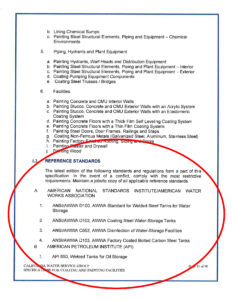
- The standards are frequently listed as “Referenced Documents/Standards” in the General Section or an Appendix
- If a standard is not part of the specification, don’t list it
- Listed standards are typically categorized by SDO (AMPP, ASTM, AWWA, API, OSHA, etc.), then numerical order
- List the Standard No. and full title (e.g., SSPC-SP 5/NACE No. 1, White Metal Blast Cleaning). Only indicate the year if intended (the latest edition typically applies)
- When subsequently referenced in Products or Execution section, include only the No. (e.g., SSPC-SP 5/NACE No. 1), not the full title
- Do not append the actual standards (unlike government standards, industry standards hold a copyright)
Pitfalls to Avoid in Conforming to Industry Standards referenced in Specifications/Procurement Documents
Now that we understand how industry standards are incorporated into project specifications, here are four pitfalls to avoid as a certified coating inspector:
- Thinking recommendation versus requirement
- Assuming “nothing’s changed”
- Using an old(er) version of a standard
- Conforming to direct requirements and not the indirect (referenced) requirements,
e.g., SSPC Abrasive Blast Cleaning Standards invoke:
- Abrasive cleanliness requirements (ASTM D7393 and D4940)
- Grease/oil removal per SSPC-SP 1
- Compressed air cleanliness (ASTM D4285)
When do Industry Standards Become Legally Binding?
Consensus standards are not regulations or laws but become legally binding when they are invoked by reference in contract documents (project specifications). They may become the basis for a lawsuit in the event of alleged non-performance
What is Involved with Standards Maintenance?
Once published, industry standards must keep pace with changes in technology, products, equipment, or processes. As a result, many SDOs review existing standards every 5 years to ensure they maintain their relevancy. A standard may simply be balloted for re-approval if changes are not needed or it may be revised, then balloted.
Many SDOs will withdraw standards that have not been maintained, i.e., after 8 years. In this case, a standard is typically balloted for withdrawal to verify there is truly no longer a need for it.
Conclusion: What’s In It for Me and My Company?
So often we hear “that’s all well and good, but what’s in it for me and my company?” Here are 4 thoughts; perhaps you can think of others:
1. You will know about standards that are on the horizon long before others.
2. You will have a voice in the content of a standard before it is published.
3. You and your company will gain name recognition – helping develop and maintain industry standards is a component to a complete marketing plan. You’ll rub elbows with existing and potential customers. You will gain their respect through your knowledge and influence in the industry.
4. It can be very rewarding to see a standard develop – from inception to publication, and know that you had a hand in the process.
Consider my “call for help.” Get involved and facilitate positive change in the standards development and maintenance arena.