
INTRODUCTION OF PAVEMENT MARKINGS IN THE US
Pavement markings have been around since the early 1900s. Some of the first ones were just stop lines painted on roads in Portsmouth, Virginia in 1907. In the early 1910s crosswalks were painted in Providence, RI, and Minneapolis, MN. The first longitudinally lined or striped roads in the United States were in Wayne County, Michigan. Some believe the line was caused by leaky milk jug on a wagon going down the road. Doctor Jeanne Robertson in 1917 was responsible for requiring center lines in the cities in California. All this was because of the many different types of forms of transportation on a wide swath between buildings. Image 1 shows some of the first automobiles, horse drawn wagons, people drawn carts, police on horses and pedestrians to observe a road divided by a single white marking.
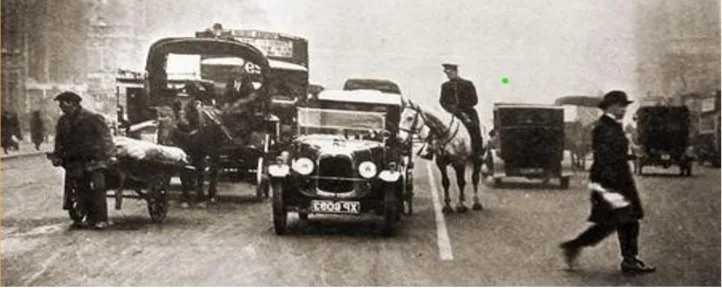
Pedestrians had the most difficult time crossing the road because of few “rules of the road.” Pavement markings in those days were mostly white. Yellow wasn’t brought in until 1934 when the first MUTCD (Manual of Traffic Control Devices) was developed. (https://mutcd.fhwa.dot.gov/kno_11th_Edition.htm ) Some of the first colors required are still part of the vernacular today. Roads could then be marked white, yellow or black. Yellow became the center lane color designating two-way traffic. Black was used during World War II blackouts due to concerns of enemy planes passing over the United States. Glass beads were introduced into these black markings so that they could be seen in moonlight by those who traveled the roads without car lights. Glass was also thought to help protect the markings from wearing too quickly.
THE EVOLUTION OF PAVEMENT MARKING COLOR AND RETROREFLECTIVITY
Here are some significant dates related to pavement marking colors and retroreflectivity:
- The 1962 Edition MUTCD banned white centerlines and made yellow the centerline marking standard.
- The 1978 Edition MUTCD mandated yellow edge lines be installed on all rural highways.
- The 1993 Edition MUTCD introduced minimum Retroreflectivity levels for all road markings.
Retroreflectivity comes from the retroreflective elements (usually glass beads) in a pavement marking material that helps a driver see the markings at night. However, the introduction of any topping to pavement marking can change the color for daytime or nighttime viewing. So, the MUTCD has Color requirements/standards for day and nighttime viewing that can be found in Code of Federal Regulations https://www.ecfr.gov/current/title-23/chapter-I/subchapter-G/part-655#se23.1.655_1603 (see Tables 5, 6 &7)
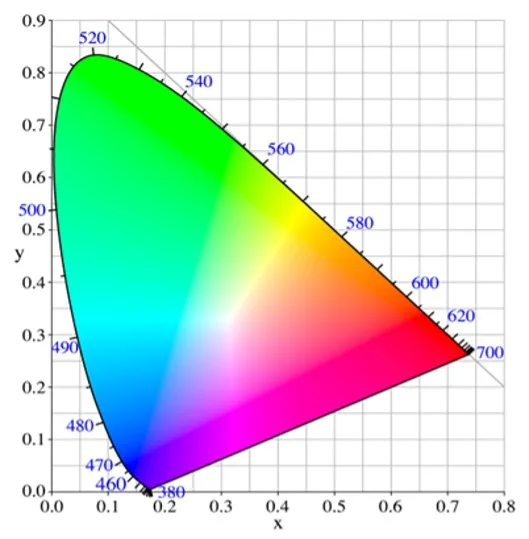
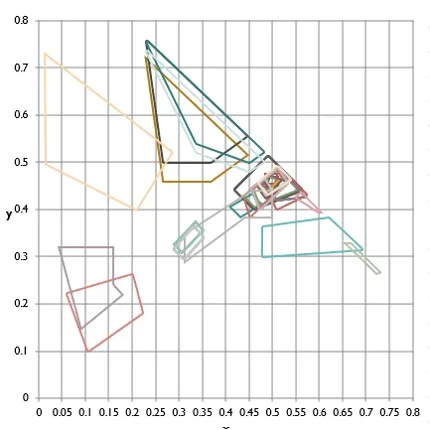
These tables have x, y color limits which when graphed and connected are color “boxes” that represent the limits of visual color allowed under day or nighttime conditions within the 1931 CIE color range shown in Image 2.
HOW PAVEMENT MARKING COLORS ARE USED TODAY
Traditional colors of yellow and white remain in use, while blue, purple, green, red, and black have been added in recent years for the reasons listed below:
- Yellow still is used to separate traffic traveling in opposite directions. It is also used for reversible lanes, median islands, and certain left-hand shoulders.
- White is used to separate traffic traveling in the same direction. It is also used for channelizing islands (gore areas) on the right side of a roadway, right-hand shoulders, and for marking parking spaces.
- Blue is normally used in addition to white markings for parking spaces reserved for persons with disabilities. Blue raised pavement markers can also indicate the location of a fire hydrant, indicating a no parking zone.
- Purple is used for preferential lanes that are for electronic toll collection (ETC) account holders
- Green is used to designate bicycle lanes, helping to define the path for cyclists and increase awareness of potential conflicts.
- Red is used for public transit systems or to indicate that a roadway shall not be entered.
- Black is used in combination with other colors to provide sufficient contrast, especially when the pavement is light in color and the markings are difficult to see in glaring sunlight.
But the colors in the MUTCD represent how markings should look when applied to the road with the drop-on “toppings”. Most of these “toppings” are known as retroreflective elements such as spherical glass bead or glass beads around a reflective core. Skid resistant aggregate can be applied in conjunction with the retroreflective elements or alone. Only a few pavement markings are manufactured in their application-finished form (reflective tapes); those pavement marking products not manufactured in a finished form which include:
- Water-Based Paint
- Solvent-Based Paint
- Epoxy Paint
- Polyester Paint
- Poly Urea Paint
- Methyl Methacrylate Paint (MMA)
- Thermoplastic pavement marking material
- Multi-component (thermoplastic + Epoxy or Urea)
- Preformed Thermoplastic
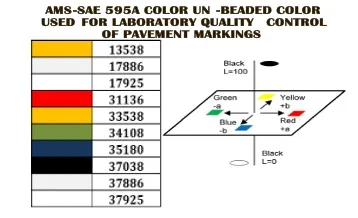
US State Departments of Transportations perform quality control testing of pavement marking products for color before they are applied to a road surface using the federal government developed Fed. Std. 595 Color standards (now the AMS-SAE 595A standards. [DE1] https://www.sae.org/standards/amsstd595a_a3-colors-used-government-procurement and https://fed-std-595.com/AMS-STD-595-Products). When an AMS-SAE 595A color is specified for a pavement marking material it is considered the base color of the pavement marking material without reflective or retroreflective elements applied to the top surface. The most common specified are AMS-SAE 595A-17886 highway white and AMS-SAE 595A-13886 highway yellow shown in Images 3 and 4.

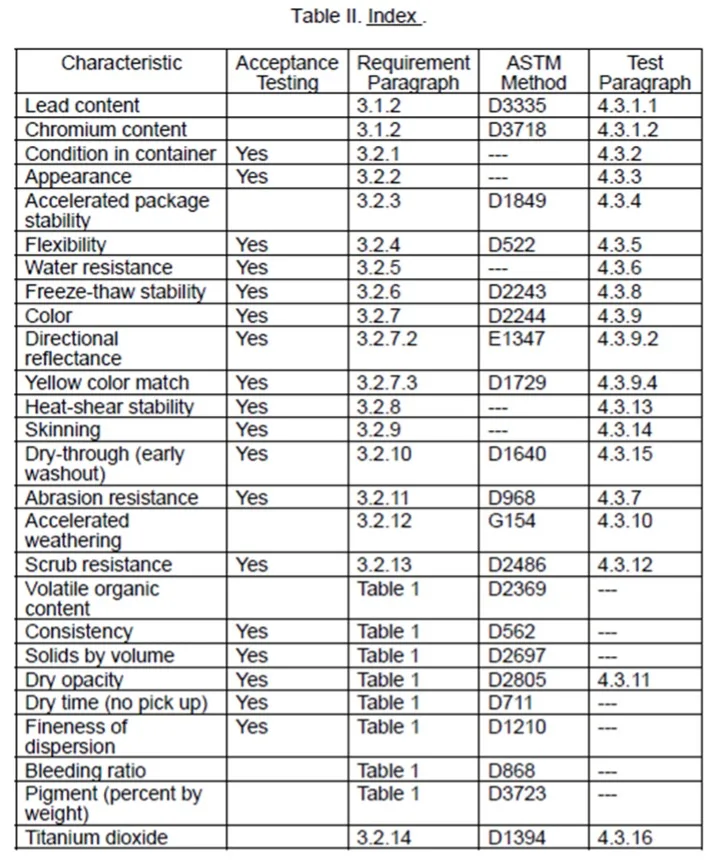
Color is one of many tests run on a traffic marking product, such as the TTP-1952F requirement shown in Table II below.
MEASURING COLOR
When testing to determine if a pavement marking material meets the general color requirement (before retroreflective elements are applied), basic daytime color measurements are made with a colorimeter. Colorimeters come with a flashing light source that can simulate sunlight, which helps indicate how the sample will look outside. A sample of the material is drawn down to a flat panel and a smooth finish, then measured for the color values that the product’s specification requires.
When needing to take measurement to compare to AMS-SAE 595A colors, it is important to use ASTM E1349 Standard Test Method for Reflectance Factor and Color by Spectrophotometry Using Bidirectional (45°:0° or 0°:45°) Geometry. Some entities may reference using ASTM E1347 Standard Test Method for Color and Color-Difference Measurement by Tristimulus Colorimetry or ASTM D2244 Standard Practice for Calculation of Color Tolerances and Color Differences from Instrumentally Measured Color Coordinates, but the colorimeter must be set to the correct illuminate and required values recorded. If an AMS-SAE 595A color standard is required, the measurements need to be obtained in L*, a*, b* values, x, y values, and Y-(brightness) or YI-CIE/#313 (yellowness index). These are the most common values required for pavement markings. A sample data set using these measurement values is shown in Image 5
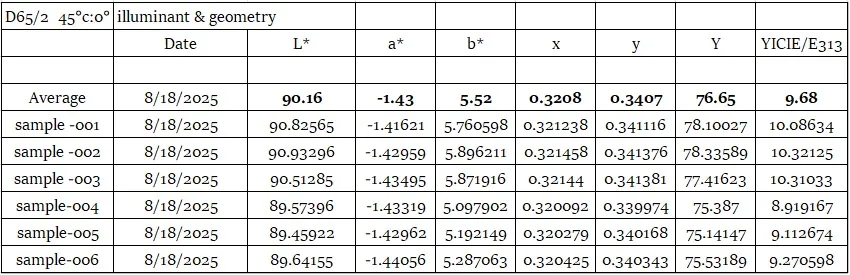
Most colorimeters can measure color in all the values described above and in the illuminant that is required, but most only show a few values at a time. If you want to be able to take many measurements quickly and record them as shown in Image 5, then you will need a computer program (the colorimeter manufacturer can provide at an additional cost) to collate that data. If a value conversion is needed without taking a measurement, Easy RGB( https://www.easyrgb.com/en/convert.php) can be used for value conversion.
OTHER COLOR MEASUREMENT STANDARDS
If measuring a thermoplastic pavement marking, ASTM D4960 Standard Test Method for Evaluation of Color for Thermoplastic Pavement Marking Materials should be used.
For Color on Retroreflective products that come from the factory or on the road and contain toppings of retroreflective elements, ASTM D6628 Standard Specification for Color of Retroreflective Pavement Marking Materials should be used. ASTM D6628 not only gives guidance on measuring retroreflective daytime color with a colorimeter, but also nighttime color with a retroreflectometer. This means that the color is measured at a simulated angle for the sightline of the driver and from the reflection of car lights instead of sunlight. Most retroreflective product requirements incorporate x, y & Y values.
Color measurement can be complex. But knowing the requirements and having the correct instrument to perform the measurements will reduce the complexity and make decisions regarding color correctness less controversial.