
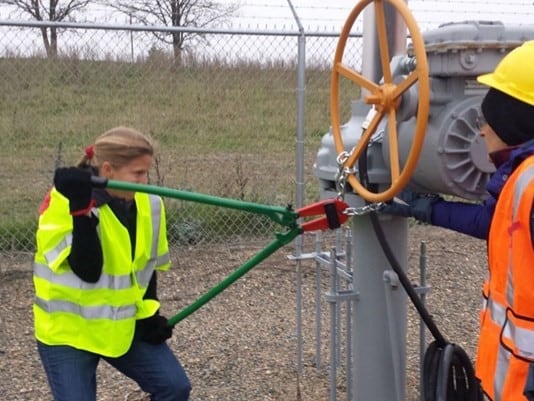
 The oil and gas production and distribution industry presents unique challenges associated with protective coatings performance. Recently, a group of environmental activists, armed only with bolt cutters, broke into valve stations across four states and closed the shut-off valves of five cross-border oil pipelines, which can transport as much as 2.8 million barrels of crude oil per day from Canada to the United States. Thankfully, in this particular case no leaks or ruptures were reported. While discussing the dangers inherent in this type of protest, one expert stated that “the oil moving through the pipelines is like a freight train. If these people were hydraulic engineers, they might be able to do this safely.” While this is an uncommon case, the environments that are created under normal operating conditions during the collection, refining, and delivery process can be very aggressive. Corrosive, low pH environments can present challenges to coated pipelines, vessels and tanks associated with the storage and transportation of fossil fuels. However, treaters, separators, pipelines and other process vessels face the added challenge of high temperature and high pressure service environments. Under normal operating conditions, delivery pipelines can face pressures up to 1000 psi and fractional distillation towers operate at temperatures over 300°C. At most times, these pressures and temperatures can be reduced in a controlled, gradual manner. However, in certain circumstances, a rapid depressurization event can occur, which can impact coating system performance and integrity.
High temperature and pressure environments can put a great deal of strain on a coating system, leading to structural changes within the coating material itself, including softening, reduced electrical impedance, thickness change, and alteration of permeability. The potential for these effects can be significantly increased if a coating is operating at or above its glass transition temperature (Tg), and the changes can affect the physical performance of a coating system. Thus, it is extremely important to determine how a coating system will perform under these adverse conditions as well as during depressurization. During depressurization, any physical changes that have occurred within the coating will reverse at varying rates. For example, if gases have infiltrated the coating material due to a change in the permeability brought about by a high pressure environment, those gases will seek equilibrium during depressurization. If the depressurization occurs faster than the gas can escape from the coating material, blistering can occur, resulting in potential coating detachment and subsequent attack of the underlying substrate by the corrosive gases.
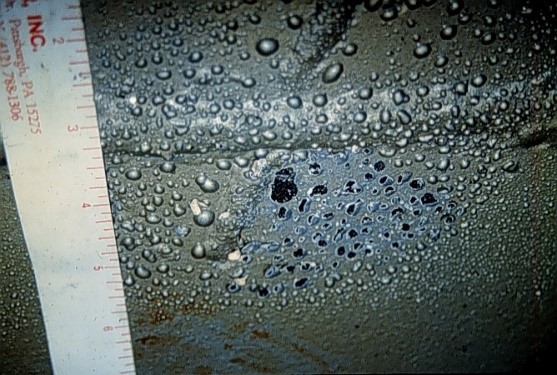 Damage to the coating film can manifest in many different ways. Some failures may not be as obvious, such as weakening of the cohesive strength of a coating material. Other failures can be very apparent, such as the appearance of blisters on the coating surface or even the spontaneous delamination during depressurization. Failures can occur during a standard depressurization; however, during rapid depressurization the strain and subsequent damage to the coating system can be increased exponentially. These effects may be more or less severe, depending on the thickness of the film build or the cross-link density of the coating material. The fluid and gas composition of the service environment will also be an important factor in determining if a lining failure will occur.
Due to the inherent stress presented by high pressure service environments, many factors must be considered when selecting a coating system, including the intended service life, the method of application, and product cost, which are all very important. However, the most important consideration should be system performance. In the event of a catastrophic failure, an oil and gas supplier could face hundreds of thousands of dollars in fines, replacement costs for damaged infrastructure, lost profit due to operational delays, and potential liability for damages or injury. Despite a potentially higher initial cost, the cost of choosing the incorrect coating material could be significantly greater. However, no two coating materials or systems are created equal. Systems of the same generic chemistry and type can exhibit very different physical and protective characteristics. Given that there are many variables to consider and that not all coating systems will perform the same, it is important to evaluate them prior to specifying them. But how can the candidate systems be comparatively tested prior to large scale installation?
One method for determining comparative performance is through the use of an autoclave. In autoclave testing, the coating materials are applied to test plates and exposed to a sequence of simulated exposures similar to those that may be encountered during actual service. In addition, autoclave testing allows for the customization of the exposure medium to allow for greater alignment with the actual service environment. Autoclave testing is designed to simulate the most extreme aspects of a service environment and can be of use in determining which coating system is best suited for a particular application. The coating materials can be applied to test plates in a controlled, laboratory environment to eliminate some of the variables associated with product application. the coated test panels are then placed into the pressure vessel and exposed to the simulated process conditions. Following the allotted time period, the coated test panels are reconditioned to ambient temperature and pressure during a “take-down” procedure, any noxious fluids are removed, and the coatings are evaluated based on ASTM standard methods to compare the performance. This take-down procedure can be performed at a gradual, uniform rate or it can be conducted to simulate a rapid depressurization situation, with full decompression being achieved within minutes.
Rapid depressurization can happen to equipment in various ways and when it is least expected. Simulating rapid decompression in a controlled environment enables assessment of relative coating performance prior to field application, which can help to prevent unexpected coating failures on in-service equipment. So, before you put a coating system into service, be sure that it can take the pressure.
 Valerie Sherbondy is the Technical Manager of the KTA Laboratory, where she has performed physical properties testing of coatings and conducted forensic coating failure investigations for over 27 years. Valerie is an SSPC Certified Protective Coating Specialist and an active member of ASTM International. She can be reached at vsherbondy@kta.com
Ms. Valerie Sherbondy
Good day to you.
I found this article very useful.
I was actually looking for pneumatic testing on refractory lining and came across this article. After discussing with my superiors, I came to understand that depressurization rate have severe consequences on the refractory as it is porous in nature.
Do you have similar experience in refractory lining of pressure vessels.?Kindly let me know.
Thank you
Best regards,
Swami.G