KTA Staff

Holiday Detection and Dielectric Strength Issues

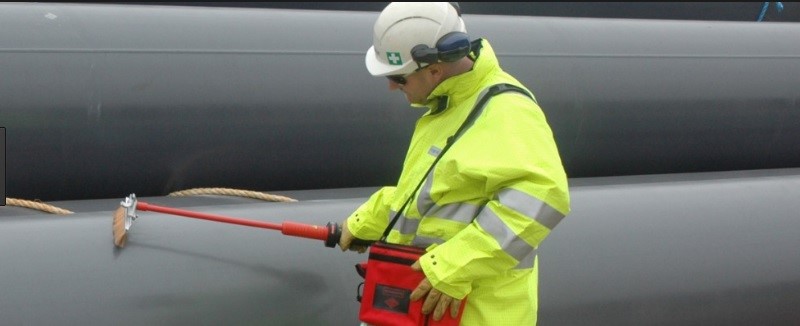
Introduction When applying coating system to structures such as bridges, tanks, and pipelines the main goal is to apply a continuous film to help prevent structural deterioration throughout the life of the structure. Unaddressed discontinuities can result in undercutting corrosion of the substrate, where the integrity of the structure could be prematurely compromised. This article

Holiday Detection and Dielectric Strength Issues Read More »

DUst Free Featured Image

What is a “Dust-Free Surface?” ISO Method Versus Practical Evaluation

When a coating system fails prematurely, it is rarely because of the coating itself. Either the surface preparation was inadequate, the surface was contaminated, or the coating was mixed or applied incorrectly. As the old adage goes, a house is only as strong as the foundation it is built on. When it comes to coatings,

What is a “Dust-Free Surface?” ISO Method Versus Practical Evaluation Read More »

Podcast #4 – Maintenance Painting vs. Remove & Replace

KTA Professional Engineers and Senior Consultants Jay Helsel & Mike Reina discuss maintenance painting including when to touch-up, overcoat, or remove & replace the coating. Scenarios are posed as the two discuss their positions on each. KTA President Ken Trimber moderates. Click below to watch via Youtube, Stream or Download on Soundcloud, or Download for

Podcast #4 – Maintenance Painting vs. Remove & Replace Read More »

Evaluating a Coating’s Resistance to Cathodic Disbondment – Guidance on Selection of Test Methods

Installation of a coating to a cathodically-protected pipeline or structure without first testing its resistance to cathodic disbondment can result in catastrophic failure of the coating. However, there are over twenty international standard test methods to evaluate a coating’s inherent resistance to cathodic disbondment; each with its own set of parameters and materials, which can

Evaluating a Coating’s Resistance to Cathodic Disbondment – Guidance on Selection of Test Methods Read More »

musculoskeletal

Preventing Work-Related Musculoskeletal Disorders Through Ergonomics

Background Ergonomics is a field study that involves the application of knowledge about physical, psychological, and biomechanical abilities and limitations of the human body. This knowledge is applied to the planning, design, and evaluation of work environments, jobs, tools, and equipment to improve worker performance, safety and health. In layperson terms, ergonomics is fitting the

Preventing Work-Related Musculoskeletal Disorders Through Ergonomics Read More »

Slip Critical Painted Bolted Connection

Podcast #3 – Slip-Critical Painted Bolted Connections

This 17 minute podcast features KTA’s Carly McGee, moderated by KTA’s Ken Trimber. It discusses key aspects of slip-critical bolted connections including testing methods, testing equipment and standards, and a discussion based on frequently asked questions.  Carly is KTA-Tator Inc.’s Physical Testing Laboratory Manager. She’s a member of the RCSC Standards Committee, which is the

Podcast #3 – Slip-Critical Painted Bolted Connections Read More »

High-Temperature Service (Heat-Resistant) Coatings: Industries, Coating Types, Testing Protocols and Consequences of Testing Inconsistencies

High temperature-resistant coatings are used in a variety of industries and markets to prevent corrosion of steel subjected to extreme temperatures while in service. There are several testing protocols that are used to evaluate the performance of these coatings; however, performance comparisons are challenging since there is little uniformity or consistency of the test methods.

High-Temperature Service (Heat-Resistant) Coatings: Industries, Coating Types, Testing Protocols and Consequences of Testing Inconsistencies Read More »

scanning electron microscopy

Application of Scanning Electron Microscopy/Energy Dispersive X-Ray Spectroscopy (SEM/EDS) in the Analysis of Coating Failures

For clear, magnified images and quick, targeted analyses of elemental composition, SEM-EDS is the method of choice. Introduction. A scanning electron microscope (SEM) can be used to examine samples at very high magnifications – up to 1 million times!  The analysis of coating failures with an SEM typically only uses magnifications up to 10,000X, however,

Application of Scanning Electron Microscopy/Energy Dispersive X-Ray Spectroscopy (SEM/EDS) in the Analysis of Coating Failures Read More »

podcast 2 shop painting v shop and field painting

KTA University Podcast #2 – Total Shop Painting vs. Shop & Field Painting

This 24- minute podcast also features Ken Trimber as moderator, while Doug Reardon advocates total shop painting and John Todd promotes shop painting with field finish coating. Scenarios are posed by Trimber as Todd and Reardon take turns providing support for their approaches while divulging plenty of information on the subject. A podcast breakdown is

KTA University Podcast #2 – Total Shop Painting vs. Shop & Field Painting Read More »

microlearning

Challenges with Adult Learning… Using Microlearning to Effectively Educate

Introduction Many employers and organizations seek training that is inexpensive, relevant to their industry/marketplace, focused on the goals of the employees as well as the organization, and can be delivered with minimal interruption to productivity.  Employees desire training that is immediate, focused, and specific to their needs. How can a course meet all expectations?  Understanding

Challenges with Adult Learning… Using Microlearning to Effectively Educate Read More »